All In the Name: Bira 91

This article examines the decline of Bira 91 rapid from a leading beer brand, attributing it to multiple governance decisions and a seemingly straightforward corporate name change that inadvertently triggered complex compliance challenges under India’s state excise regulations. It highlights how a poorly timed or inadequately executed corporate actions, particularly during the sensitive transition from a private to public company, can result in significant regulatory, financial and strategic consequences especially within the context of India’s increasingly IPO-driven environment.
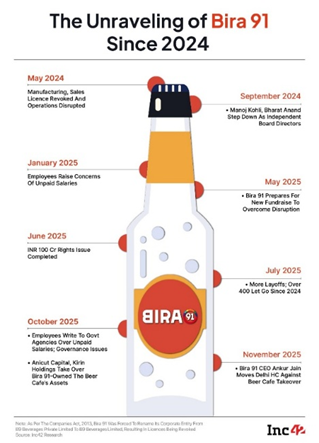
Image Source: https://inc42.com/features/inside-the-bitter-collapse-of-bira-91/
In December 2022, B9 Beverages Pvt. Ltd., the company behind Bira 91, changed its name to “B9 Beverages Ltd.” Under Indian state excise laws, the new name was treated as a new legal entity, requiring fresh excise licences, label approvals and product registrations for each beer variant in each state where the product was sold. Consequently, while the financials reported a revenue of approx. USD 86 million in 2021-2022, this declined sharply to USD 66.70 million by 2023-2024. The company’s total loss escalated to USD 77.12 million, prompting auditors to question its ability to continue as a going concern, derailing its earlier ambition of launching an IPO in 2026.1 Further, as per a press coverage, a proposed USD 59.9 million investment by BlackRock reportedly fell through.2 Furthermore, in October 2025, Kirin Holdings (its largest shareholder) and Anicut Capital (its lender) invoked their convertible equity rights and took control of assets under Better Than Before (BTB), the entity operating The Beer Café chain and other F&B ventures. Founder Ankur Jain has challenged this before the Delhi High Court.
LEGAL CONTEXT
As alcohol is a State subject under the Constitution of India (Entry 8 of List II of the Seventh Schedule), each State of India independently prescribes its own excise laws, labelling norms, and licensing regimes.
For instance, Section 20 of the Delhi Excise Act, 2009, read with the corresponding rules, expressly prohibits the transfer of an excise licence without prior approval of the licensing authority. Similarly, the West Bengal Excise (Transfer of Licence) Rules, 2023 mandate that any establishment seeking a change in its registered name is required to submit a formal application for approval. By contrast, the Andhra Pradesh Excise Rules include an exception for a “mere change of name keeping the entity intact”; however, this does not apply where there is a change in the corporate form, such as a conversion from a private limited company to a public limited company, which is deemed a material change and therefore falls outside the scope of the exception.
The absence of a jurisdiction-specific statutory analysis and a comprehensive pan-India regulatory impact assessment prior to executing a corporate action such as a name change directly resulted in a commercial standstill, significant revenue losses, and widespread operational disruption
The Companies Act and state excise statutes operate in entirely distinct regulatory fields. While the Companies Act is concerned with corporate personality, governance, internal restructuring and shareholder rights, excise laws are directed towards public revenue, state control over manufacture, distribution, and sale of alcohol. In More Retail Private Limited v. State of Karnataka,3 Karnataka High Court held that the Karnataka Excise Act, 1965 and the Karnataka Excise (General Conditions of Licences) Rules, 1967 do not recognise “name change” of a licence holder. The name change under the Companies Act has no effect on excise licensing. Thus, any change in corporate status must conform strictly to the circumstances listed under Rules 17, 17-A, and 17-B of Karnataka Excise (General Conditions of Licences) Rules, 1967, or otherwise requires prior approval. The Companies Act cannot be invoked to compel excise authorities to treat a renamed company as the same licence holder when the excise statute does not recognise such continuity.
OUR THOUGHTS
The case of Bira 91 highlights the critical need for a thorough legal and regulatory due diligence in India’s IPO-driven landscape. Seemingly routine corporate actions like name changes of a company can trigger complex, sector-specific compliance obligations that extend beyond the Companies Act. Given the federal structure of India’s regulatory regime, it is essential to undertake a granular, state-by-state mapping of applicable laws, particularly in sectors governed by stringent local statutes such as excise, gaming, non-banking financial services, food safety, telecommunications, and environmental regulation. Bira 91’s experience serves as a cautionary tale that even a procedural change, if mishandled, can have disproportionate and potentially irreversible consequences on a company’s commercial trajectory.
The information contained in this document is not legal advice or legal opinion. The contents recorded in the said document are for informational purposes only and should not be used for commercial purposes. Acuity Law LLP disclaims all liability to any person for any loss or damage caused by errors or omissions, whether arising from negligence, accident, or any other cause.
- Article by Business Today dated October 10, 2025 (can be accessed at https://www.businesstoday.in/latest/corporate/story/the-fall-of-bira-91-how-a-simple-name-change-sparked-the-collapse-of-indias-coolest-beer-brand-497645-2025-10-10?) ↩︎
- Article by The Economic Times dated October 10, 2025 (can be accessed at https://economictimes.indiatimes.com/industry/cons-products/liquor/bira-91-india-craft-beer-ankur-jain-turbulence-staff-move-plea-for-leadership-change/articleshow/124448175.cms) ↩︎
- 2021 SCC OnLine Kar 15576. ↩︎